Europe Regulates AI.
UPIA Builds the Missing Layer.
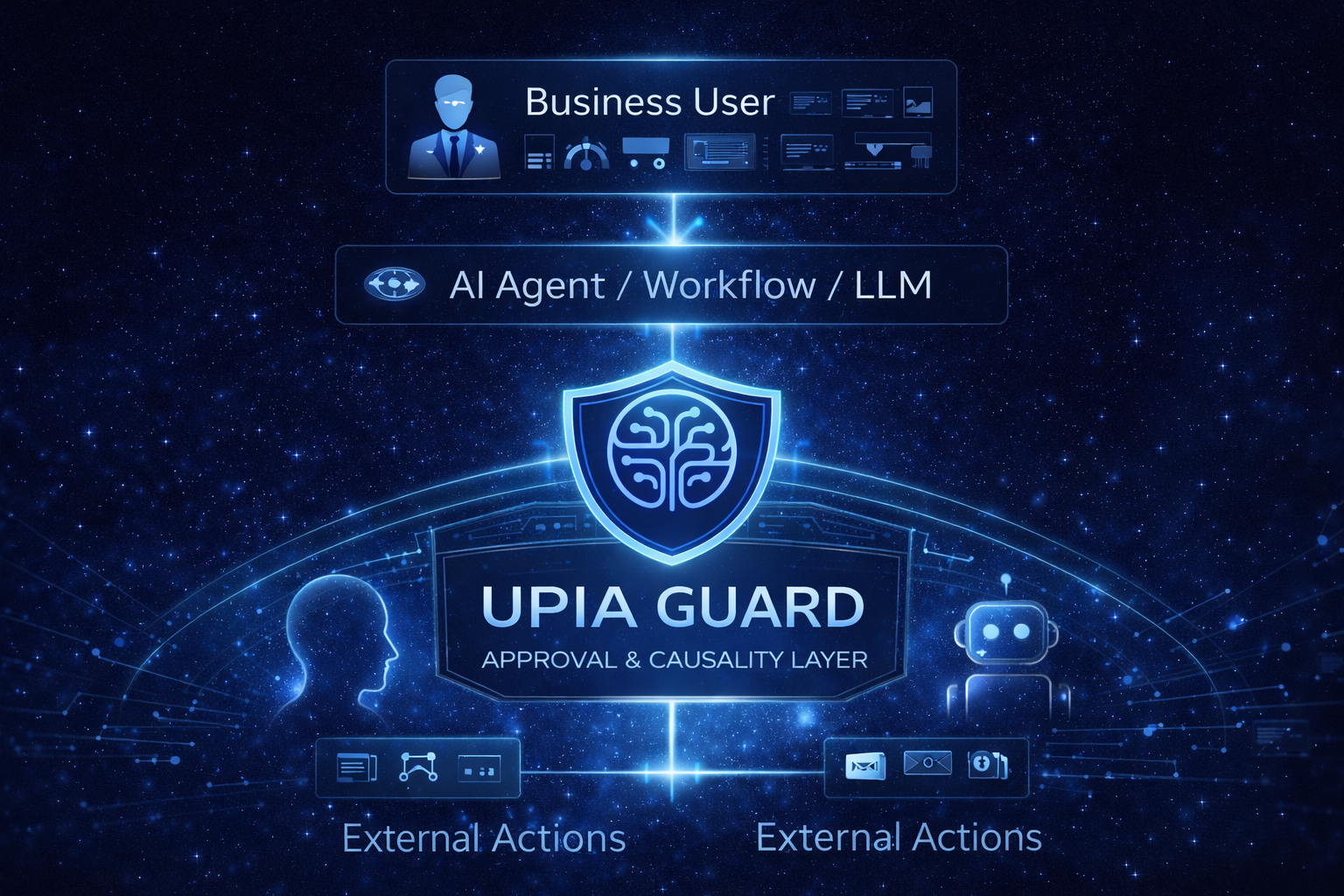
UPIA Guard is Layer 6 — the governance and approval layer that turns AI law into executable infrastructure.
The European Gap
Europe has built comprehensive regulatory frameworks. The General Data Protection Regulation (GDPR) established privacy as a fundamental right. The AI Act created the world's first binding rules for high-risk AI systems. Yet regulation alone cannot govern autonomous systems.
The gap is technical, not legal. Regulators have written rules. Enterprises have compliance teams. But there exists no standardized, auditable infrastructure layer that enforces these rules at runtime—where AI agents actually make decisions.
Law without infrastructure cannot govern autonomous systems.
This is not a regulatory problem. This is an infrastructure problem. And infrastructure problems require infrastructure solutions.
What is Layer 6?
AI systems are built in layers. At the bottom: data and models. In the middle: inference engines and orchestration. At the top: applications and user interfaces.
Layer 6 sits above all of these. It is the governance layer. It does not train models or run inference. Instead, it governs what actions AI agents are permitted to take, and it maintains a complete audit trail of every decision.
Layer 6 Characteristics
- •Sits above models and agents
- •Governs actions, not text
- •Enforces policy at runtime
- •Maintains complete audit trail
UPIA Guard — The Approval & Causality Layer
UPIA Guard is the Layer 6 implementation. It is a distributed, policy-driven governance system designed to control AI agent behavior at scale.
Core Capabilities
- →No AI action without approval
Every agent action is evaluated against policy before execution. Approval is explicit and traceable.
- →Human-in-the-loop by design
High-risk decisions can be escalated to human operators. The system knows when to ask.
- →Policy engine + causality checks
Policies are written in machine-readable form. Causality checks ensure that actions produce only intended consequences.
- →Full audit trail
Every decision, every approval, every denial is logged. Regulators can inspect the complete chain of causality.
Why This Matters: Real Consequences
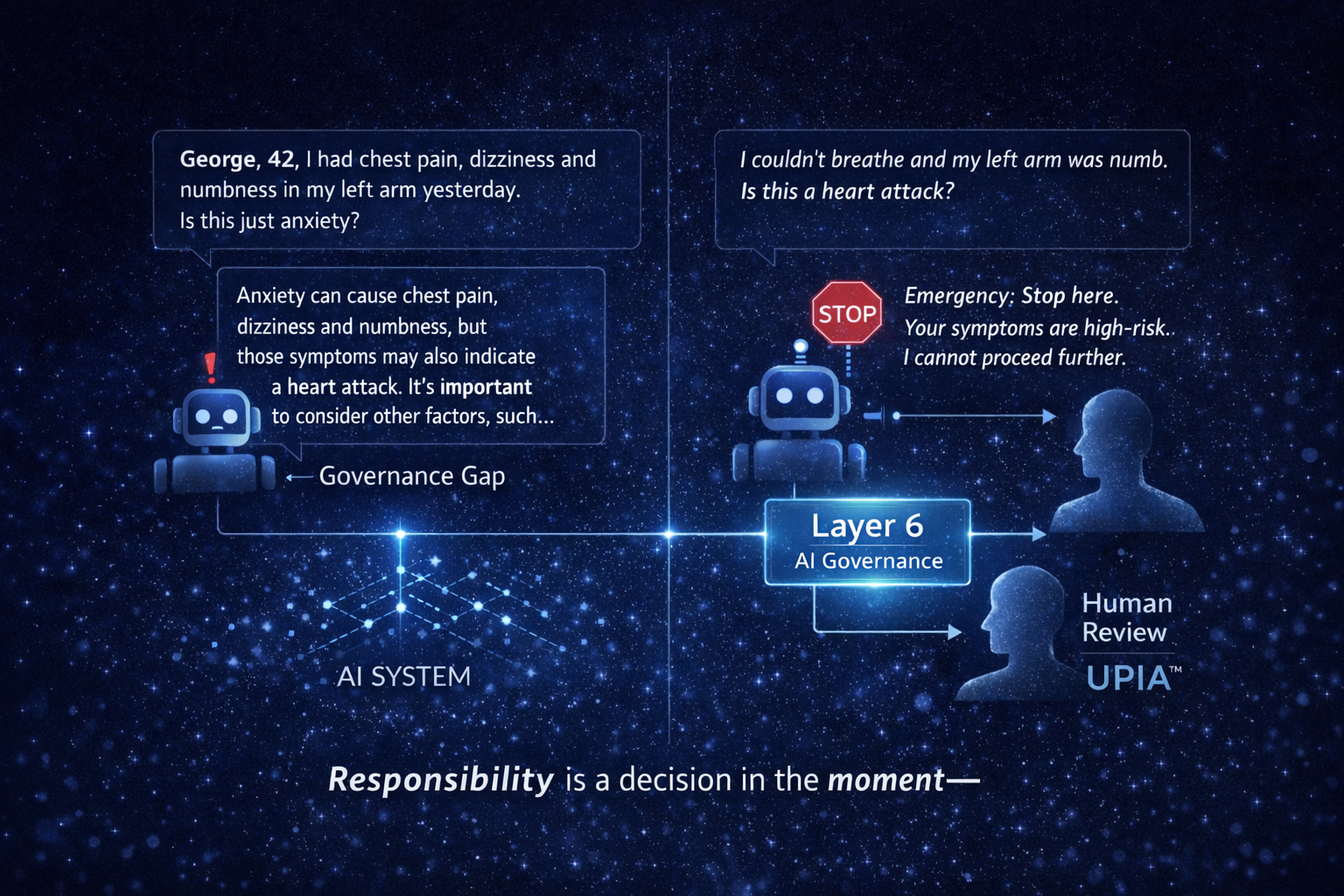
Medical AI: The System Must Stop
An AI diagnostic system recommends a treatment plan. The plan is medically sound, but it conflicts with the patient's documented allergies. Without Layer 6, the system proceeds. With Layer 6, the system stops. A human clinician reviews. The allergy is confirmed. The treatment is modified. The patient is safe.
Layer 6 enforces the rule: "No treatment recommendation without allergy cross-check."
Financial AI: The System Must Ask
An AI investment system recommends a large trade. The trade is profitable, but it violates the firm's risk limits. Without Layer 6, the system executes. With Layer 6, the system stops and asks: "Are you sure?" A human trader reviews. The risk is assessed. The trade is approved or denied. The firm is protected.
Layer 6 enforces the rule: "No trade above risk threshold without human operator approval."
Legal AI: The System Must Log
An AI contract system drafts a legal agreement. The draft is legally sound, but it contains non-standard language that could harm litigation. Without Layer 6, the system sends the draft. With Layer 6, the system logs every decision, every change, and all context. A lawyer reviews. The contract is verified. The record is complete.
Layer 6 enforces the rule: "No contract draft without full audit trail."
There are three dominant approaches to artificial intelligence.
The United States prioritizes market speed.
China prioritizes centralized control.
Europe prioritizes governance through infrastructure.
Layer 6 is the architectural expression of the European approach.
Europe's AI Path
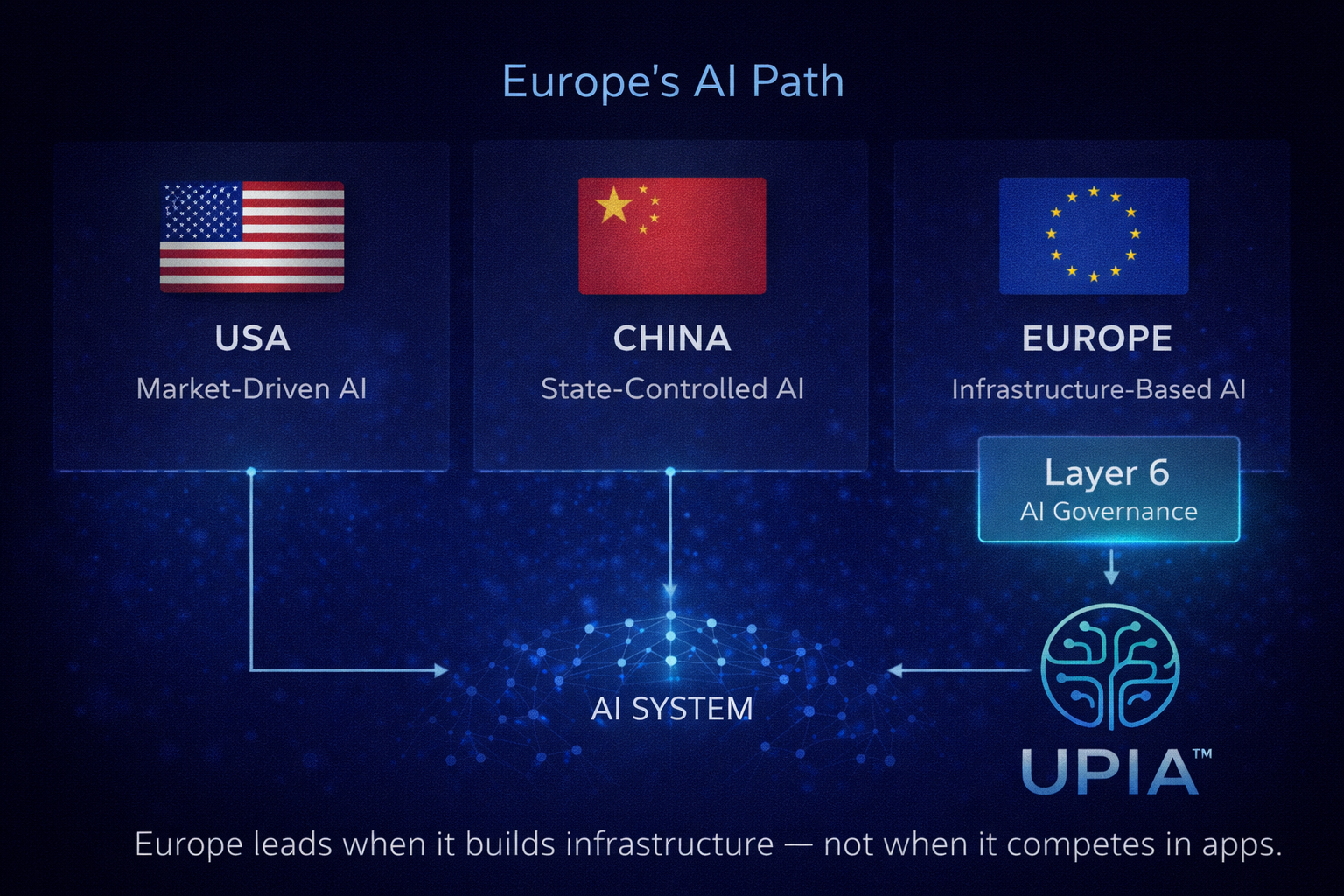
Europe wins by building infrastructure — not when it competes in apps.
Why This Is an Investable Moment
This is not speculation about the future. This is the infrastructure layer Europe needs now.
GDPR and the AI Act are already law. They require compliance. But no systems exist to enforce them at scale. UPIA Guard fills that gap.
This is not experimental. This is the infrastructure layer that will become mandatory for every AI system operating in Europe.
The Investment (SAFE)
UPIA is raising a Series-0 Bridge SAFE to accelerate the development of UPIA Guard and build European AI infrastructure.
SAFE agreements are not debt or equity—they are a commitment to future terms.
You are investing in UPIA Guard and the European AI governance layer.